

Your ad spend has a receipt. Most agencies never show it.
Meta. Google. YouTube. We run all three against one number — the dollars that came back — and we follow a click past the form fill, into your CRM, to the deal that actually closed. Impressions are not proof. Closed revenue is.
You're spending. You can't prove it.
Everybody can see what leaves the account. Almost nobody can see what came back. If one of these sounds like your week, the budget may not be what's broken.
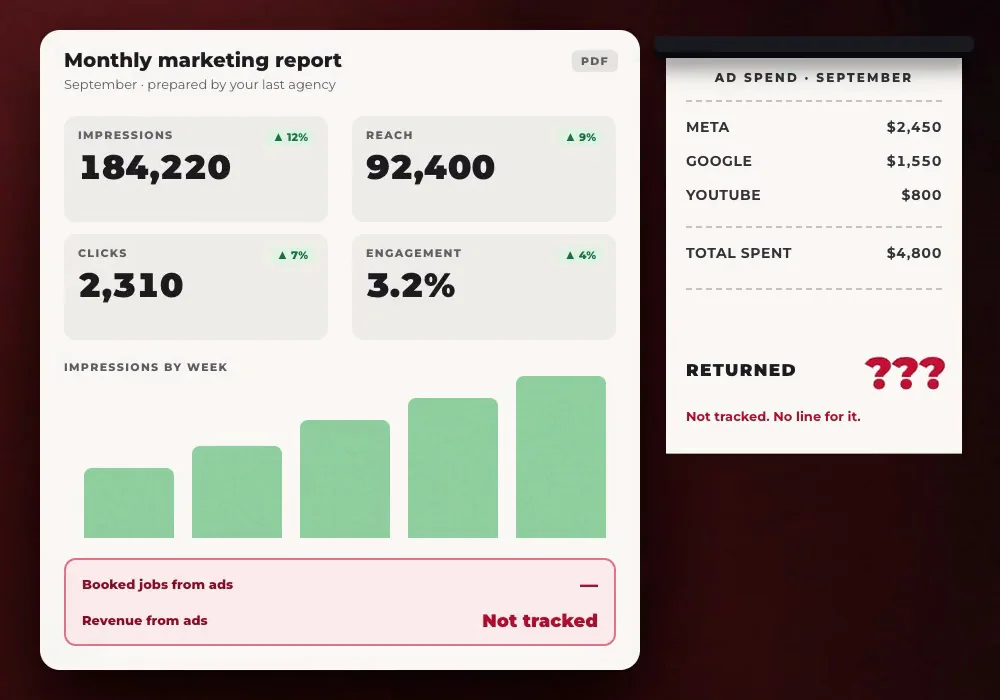
Where did the last budget go?
Spend went out. A PDF came back full of impressions, reach, and "engagement." Not one line of it tied to a booked job. You paid for activity, then paid again for a report about the activity.
Do leads from ads close like referrals do?
Referrals feel like gold; ad leads feel like a gamble — but you have no number to compare them. Without closed-loop attribution you're optimizing blind, scaling the wrong campaigns and starving the ones that pay.
Is creative the real bottleneck?
Meta and Google will eat every dollar you give them. The constraint is fresh, on-brand assets — static, motion, UGC — produced fast enough to beat ad fatigue. You can't keep up, so performance decays.
Every dollar tracked, tested, tuned.
Spend in, leads out, revenue back, read end to end. This is sample data, and the columns are the point. It's the one report your ad account should be able to produce on demand.
$ sacred report --window 24h --channels all
META spend → leads → closed revenue
GOOGLE spend → leads → closed revenue
YOUTUBE spend → leads → closed revenue
— matching leads → CRM → closed revenue …
blended spend vs closed revenue, both columns filled
— bid algos refed with closed-revenue signal
creative fatigue: healthy sets kept · tired sets flagged for refresh
Campaigns end. Engines compound.
Creative supply, platform-native execution, closed-loop attribution — wired so the bid algorithm optimizes against money instead of against a slide. You learn what a customer costs and what one returns before the next dollar leaves the account. One of the three usually does most of the lifting.
-
Creative-first ad system
Static, motion, and UGC — all on-brand, refreshed weekly, A/B tested against live spend. Your content engine feeds the pipeline, so fresh assets land before fatigue sets in. Creative stops being the bottleneck.
-
Cross-platform management
Meta, Google, and YouTube — with genuinely different playbooks per platform, not one budget split four ways. Each channel run to its own strengths: demand capture, demand generation, and retargeting that actually compounds.
-
Closed-loop attribution
Pipeline and closed revenue fed back into the platforms. The bid algorithm learns from real dollars, not surface clicks — so it scales the leads that close and starves the ones that don't. The dashboard finally tells the truth.
Creative supply is usually the constraint. Same budget line, different return line.
Paid is reach. Search is the moat.
Every dollar on this page has a switch behind it. Stop paying and the leads stop the same afternoon. Rankings don't work that way — they're an asset on the other side of the ledger, and they keep paying after the spend ends.
SEO & Google Strategy → The discovery layer
Spend buys the lead. See what works it.
The ad is the cheap part; what happens in the ninety seconds after is where the money goes. The builder sketches the system that catches the lead and books it — name the bottleneck, forge the stack, watch it assemble.
Put every ad dollar on the books.
Thirty minutes, screen shared, your account open — where the spend leaks, what the creative loop is missing, and the one number to move first. No pitch. If you never hire us, you still leave with the read.
Prefer to talk now? Call (239) 518-3654